Showing posts with label collaboration. Show all posts

Monday, February 12, 2024

Joe Puente ponders “Film Day on the Hill”

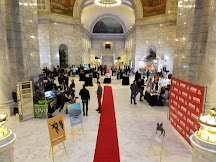
Every year, during the bureaucratic lightning round that is Utah’s legislative session—from 2017–2020—there has been a designated “Film Day on Hill” held in the Capitol Rotunda in Salt Lake City.

Film Day 2018 image courtesy of
Utah Filmmakers Associate Marshall Moore

Coordinated by the Motion Picture Association of Utah (MPAU), it was always a fun time for friends and colleagues in the local film industry to gather to support Utah’s Motion Picture Incentive Program and the Utah Film Commission—the agency tasked with implementing it.

Film Day is often commemorated with a group photo!

Film Day 2020 image courtesy of the Utah Film Commission

The group photo from 2020 reminded me of a classic horror film, inspiring a short homage to the late director Stanley Kubrick.

Video by the author

Because of the pandemic, in 2021 and 2022, Film Day was an online event.

Coincidentally, February 17
is also the author's birthday.

Since 2023, Film Day has become part of “Cultural Industry Advocacy Day,” so the MPAU joins several other organizations and entities like Hogle Zoo, the Professional Outreach Programs In The Schools (POPS), the Utah Cultural Alliance, the Utah Museums Association, and Salt Lake County’s Zoo Arts & Parks (ZAP) Program, making for a more engaging public experience.

Film Day 2023 image courtesy of Utah Film Studios

I remember registering for Film Day last year and looking forward to it more than usual after two consecutive virtual gatherings—I even preordered a box lunch.

Alas, I was struggling with some intense anxiety and couldn’t make it—2023 had a rough start for me. Thankfully, UFA™ VP Mario DeAngelis could go, so the Utah Filmmakers Association was represented, and the lunch I had ordered didn’t go to waste.

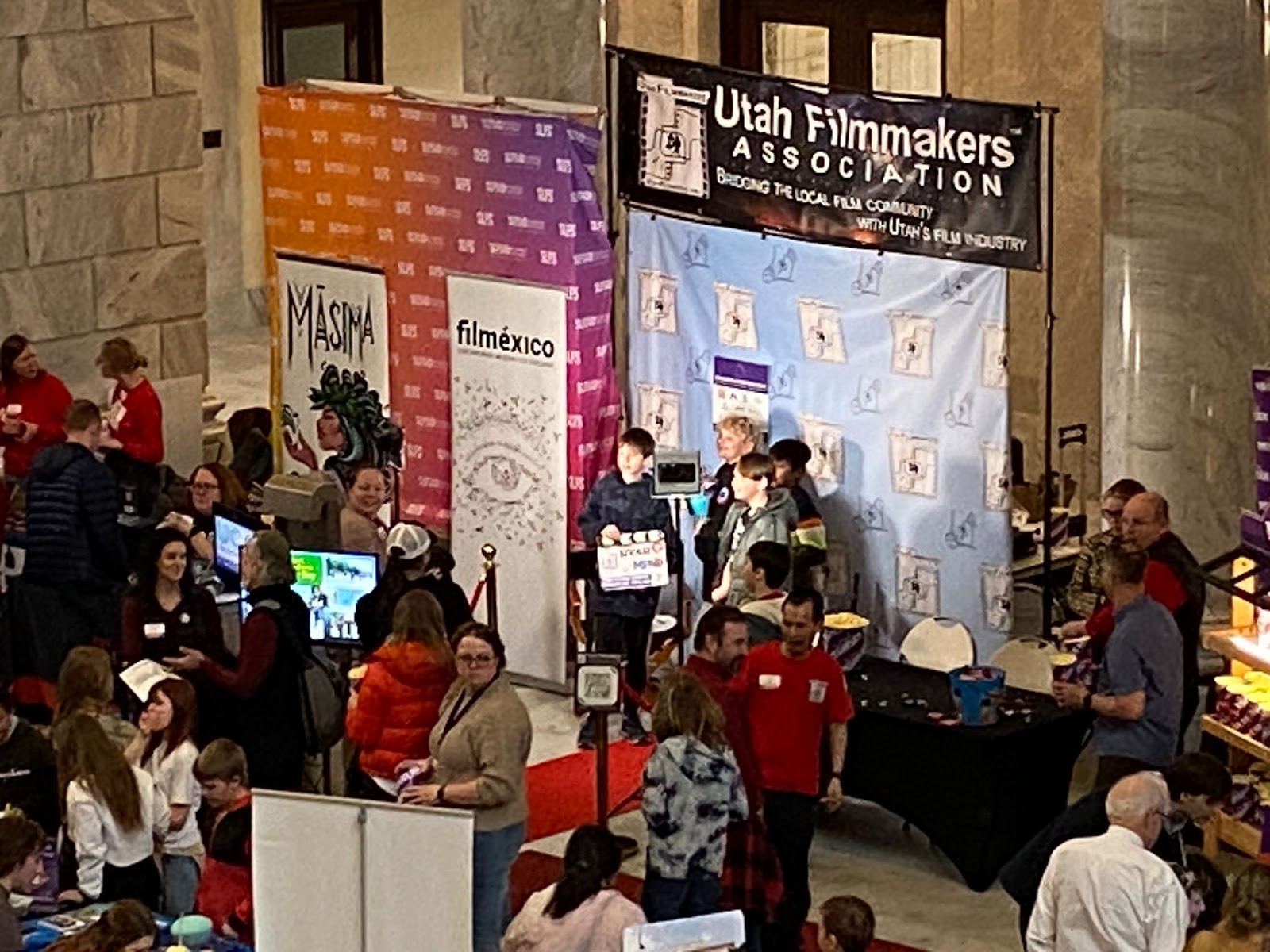
Cultural Industry Advocacy Day 2024 presented an opportunity for the UFA to connect with more of Utah’s film community, as well as other local nonprofits. We enlisted the services of Associate Member DB Productions Utah to answer a call from the event organizers at the Utah Museums Association to have an “interactive exhibit” in the Capital Rotunda. We were given a prime location between the Salt Lake Film Society and the Sundance Institute. Unfortunately, no one from Sundance was at their table. As we said in our Instagram post, “...we were happy to step up and make sure their allotted space still represented them. We happened to have a piece of Sundance Film Festival history... displayed on their table: An authentic Sundance Film Festival Rejection Letter. They don’t send those out anymore.

Dare I ask if the Utah Filmmakers Association stood out
among the other exhibitors? Images courtesy of the author

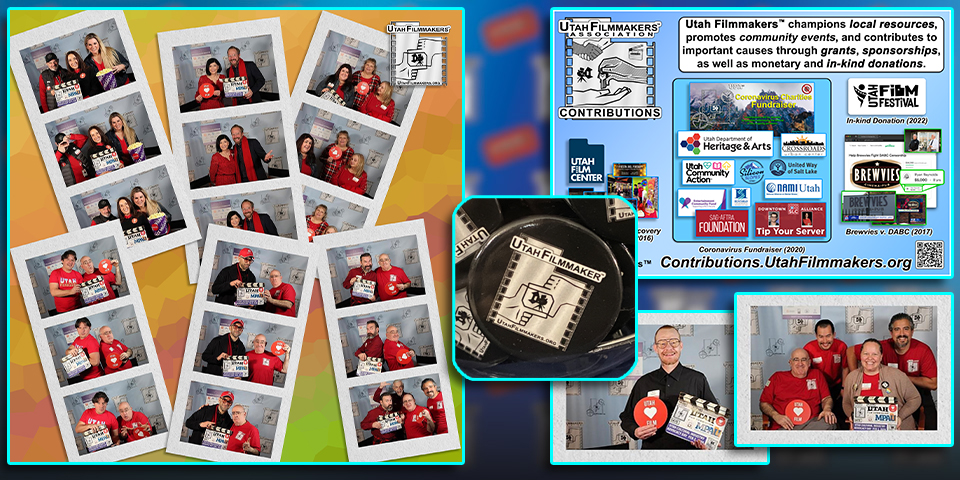
In addition to the novelty of DB Productions Utah’s signature photo kiosk—book them for your event today!—we gave out official Utah Filmmaker buttons.

Images courtesy of DB Productions Utah and Utah Filmmakers

We also presented two slide shows: One featuring our Associate Members and the other highlighting the organization’s engagement with the community, production support, and other contributions since its founding in 2002.

The slideshows were presented silently on the day, but the versions we’ve made available through YouTube—now featured on our website—have incorporated licensed soundtracks courtesy of Associate Organization Amphibious Zoo Music.

We also want to express our gratitude for the assistance of two of our Community Liaisons, Justin Kwan and Jared Palmer.

The opinions expressed in this blog are those of the authors and—especially where guest posts are concerned—do not necessarily reflect the official policies of the Utah Filmmakers™ Association, its Officers and/or Associates.


Monday, August 21, 2023

Having integrity above and below the line

Someone who makes a mistake during production may or may not be tasked with fixing it. It might require a filmmaker with more experience to take the lead—thus, a teachable moment presents itself. Whether or not that translates into an actual learning opportunity depends on an individual’s willingness to own their mistake. To do so requires humility, self-awareness, and honesty—with everyone, including oneself. In other words, integrity.

Some people never get passed their own cognitive biases and keep making the same mistakes over and over again. This stems from an inability to be honest with themselves, reinforcing their biases and fueling their egos. Such individuals may become technically proficient elsewhere in the process. Still, their unwillingness to learn from their biggest mistakes and/or acknowledge their own weaknesses gets rewritten in their memories as they continue to repeat them and disregard anyone who dares to suggest a better/more efficient way of doing something—such as an established technical or industry standard. This is the way of the faux-pro (“faux-professional”).

What others recognize as stubbornness and foolish pride is simply rebranded in the faux-pro’s mind as “doing things my own way” or “establishing a new paradigm,” often justified with repeated clichĂ©s like, “Sometimes you’ve got to break the rules.” They fail to recognize the difference between experimenting with new techniques within an established framework and trying to cut corners or take shortcuts that will undermine their own efforts.

For example, a scene in a motion picture will typically change shots every five-to-ten seconds. Cutting from one person to another during dialogue, maintaining a consistent angle for each character, never exceeding a typical duration. This is one of those artistic “rules” established over a century of narrative filmmaking—but it isn’t carved in stone, it’s not included in any contract, nor does any union mandate it.

An amateur filmmaker who doesn’t understand that “rule” might break it unintentionally, resulting in a confusing final edit that momentarily distracts the audience and ruins the experience of the film.

A filmmaker who does understand the “rule” may intentionally break it for dramatic effect. Chaotic, emotional dialogue can be well served by randomized, atypical camera angles, heightening the audience’s emotional response to the scene. An extended, single take on a character struggling to concentrate on the events around them can elicit discomfort in the audience.

However, when the “rules” that are being broken are actual rules, like labor laws or the laws of physics, it doesn’t usually end well for the self-styled “rebels” doing their “own thing.”

Faux-pro filmmakers are everywhere. They’re very good at creating notoriety for themselves—typically limited to their own sphere of influence—with a visually impressive resume/C.V. A quote attributed to Stalin—or an American Defense consultant in the 70s, depending on who you ask—seems apropos when taking only a cursory glance at a faux-pro’s IMDb page: "Quantity has a quality all its own."

It’s important to remember that a demonstrable lack of integrity does not necessarily indicate a moral failing—an ethical deficiency, perhaps—but, as stated above, such a deficit goes hand-in-hand with a lack of self-awareness. A personality trait with myriad potential root causes that this writer is not qualified to examine.

However, integrity is vital to maintaining a sustainable career in any industry. Especially one that relies heavily on expansive collaboration between multiple disciplines with time-sensitive workflows. Faux-professionals are quite good at freezing themselves out of such opportunities, but they can still affect others they work with, who—upon breaking an actual rule—may feel the pain of being fired from an industry project because they never learned how to own their own mistakes. This doesn’t mean that they can’t still learn. Breaking bad habits and understanding the distinction between personal and professional judgments is still possible. Opportunities to examine one’s mistakes and failures should not be squandered with self-pity when so much can be gained from self-reflection.

One may even learn to appreciate the “wasted” time appealing to the egos of faux-pros. Not everyone gets a front-row seat to a demonstration of how not to do something. Limiting one’s judgment to the criteria demanded by professionalism can also help put the faux-pro’s unfortunate habits into proper perspective. They may be self-serving narcissists dispelling bad advice and empty promises, but that does not make them quantifiably evil.

In the words of Robert J. Hanlon:

"Never attribute to malice that which is adequately explained by stupidity."

Founder/Administrator
Utah Filmmakers™ Association

The opinions expressed in this blog are those of the authors and—especially where guest posts are concerned—do not necessarily reflect the official policies and/or practice of the Utah Filmmakers™ Association, its officers and/or associates.

Tuesday, August 15, 2023

Integrity requires owning one’s mistakes

In the late summer of 2019, I contacted a member of our official forum via direct message to clarify some points of confusion in a recent comment thread. Our conversation was mostly productive, but I felt something was missing that couldn’t be effectively communicated online. So, I invited him to meet at a local coffee shop, which made all the difference. Travis Babcock is now one of our Official Forum Moderators and a Utah Filmmakers Associate.

One of the topics we discussed was the importance of mentorship for training new filmmakers. At the time, Facebook had implemented a mentorship feature that we enabled for the Utah Filmmakers group, and several members, including Travis, were able to get some productive use out of it.

While Facebook offered few tools for moderators to determine who was and was not qualified to effectively mentor novice filmmakers into the industry, Travis and I decided it could still serve as a pilot program for something more formal and organized. This included defining standards and a vetting process. One of the standards Travis recommended is part of our UFA™ Core Values:

Integrity

I asked Travis, “How does one assess a person’s integrity?”

His answer: “A willingness to own one’s mistakes.”

“I’ve made many mistakes,” Travis continued, “but I always owned them, learned from them, and rarely made the same mistake twice. This doesn’t mean that I don’t still make mistakes—because I do—but the ones I make now are much smaller than those I made when I was starting out.”

What I found especially appealing about this simple truth is that one can apply it anywhere: professionally and personally, in one’s work, art, and even in one’s relationships—be they social or in business.

As a filmmaker, every production presents new creative and technical challenges and opportunities to learn—opportunities that usually come in the form of mistakes made. Some mistakes just need a quick adjustment and a second take. Others can be “fixed in post.” Some can cost a shot, a scene, or even a production day. Sometimes, there is no fix, and what may have seemed like only a setback is the first sign of a complete failure.

As a member of the Utah Filmmakers™ group—especially in my role as an Administrator—I’ve made mistakes and tried my best to own them, rectify them, commit to learning from them, and—most importantly—be transparent about them.

The conversation between Travis and myself informed the creation of a mentorship program intended to go beyond what was offered in our Facebook group. Additional advice was sought, other tools researched, and a detailed proposal was written. The program was then presented to the Utah Film Commission, who agreed to help us with our vetting process—with a particular focus on the importance of integrity.

In 2021, the Utah Filmmakers Association received a modest grant to help promote this new program to attract mentors in the film industry and mentees committed to learning. We reached out to the local media and other nonprofit organizations. I made a couple of television appearances and radio interviews. Applications for potential mentors and mentees came in, many were selected, but a few were not. Mentors were assigned their mentees and provided with tools to help them facilitate their journeys.

I wish I could say that the program was a success and continues to meet its objectives, but being true to our organization’s core values of Professionalism, Integrity, and Respect, requires acknowledgment that it went nowhere. It was, for all practical purposes, a failed experiment. I wouldn’t call it a “spectacular” failure. It was pretty quiet and unremarkable—but no less of a disappointing experience, which reminds me of an important truth:

So, what did we learn from this failure?

That some things cannot be forced—no pun intended—into existence. We might be able to create and present opportunities, provide tools and make introductions, but we can’t predict what people will do or determine the final outcome. Some things lend themselves well to artificial facilitation, but only under specific circumstances. Others are just meant to happen organically, and that’s okay. It’s true of nonprofit programs, for-profit endeavors, and online communities. What’s important to remember is that one’s mistakes or failures are not an accurate gauge of one’s integrity, but how one responds to them can be very informative.

Joe Puente Founder/Administrator Utah Filmmakers™ Association


The opinions expressed in this blog are those of the authors and—especially where guest posts are concerned—do not necessarily reflect the official policies and/or practice of the Utah Filmmakers™ Association, its officers and/or associates.

Monday, May 8, 2023

Filmmaking is NOT a hobby!

The Utah Filmmakers Association does not set out to discourage anyone striving to work in the film industry, but one cannot espouse Professionalism, Integrity, and Respect without complete honesty. It must also be acknowledged that some of the terms we’ve used in reference to community filmmakers, while intended to make those lacking professional experience feel welcome and included, may not have been helpful to the organization’s Mission. Emphasis has always been placed on our Vision, yet confusion persists about what “filmmaking” represents within our society and culture.

Is filmmaking an art form or a business?

More to the point, can filmmaking just be considered an art form without all the baggage associated with “business” and “industry”? Our response may disappoint some, but the entire premise of the question is false. It assumes that the “art” and “business” of filmmaking exist independently—they do not.


While some might not like to hear it, the business of filmmaking is a definitive and inextricable component of the art form because of its collaborative nature. When two or more individuals agree to cooperate on a project—regardless of whether or not it’s artistic, commercial, public, or personal—they have entered into an implicit contract and are conducting business amongst themselves. Whether or not it was discussed in advance, the project will create a unique asset that did not exist previously—an idea or an object—a commodity that will have value to someone. As such, an owner—or owners—must be identified and agreed upon by everyone involved in its creation.

Too many community filmmakers have misappropriated the word “hobby” to describe their involvement in filmmaking. Such use is damaging to the industry and the art form. Filmmaking cannot be described as anything approaching the definition of a hobby. It never has, and it never will. It’s certainly not something that’s done to relax—it’s difficult, challenging, and often stressful work. While anyone can derive a great deal of satisfaction from their efforts and enjoy the process, filmmaking is not something that can be picked up and put down at anyone’s leisure; and is rarely undertaken as a solo activity. The collaborative aspect of the art form requires a level of commitment that does not allow for casual participation. No one can be expected to drop by a set when they have a spare minute to help out. While improvisation can and does happen on film sets—in front of and behind the camera—no one can improvise the creation of a motion picture.

One may attempt to counter this point by referencing the 48-Hour Film Project, but that would require ignoring all the logistical considerations required to participate in it.

There is no such thing as a “hobbyist filmmaker”

There are amateur filmmakers, yes. Do some amateurs refer to themselves as “hobbyists”? Some do. The colloquial use of the term “hobby” notwithstanding, anyone self-identifying as a “hobbyist filmmaker” is doing a disservice to themselves, the industry, and the art form. It also devalues the hard work of industry professionals in the public's minds in a way that would be unthinkable in any other line of work.

INT. SUBURBAN COCKTAIL PARTY - NIGHT

Two of the host’s mutual acquaintances are making small talk.

LAY-PERSON
So, what do you do?

PROFESSIONAL
I’m a neurosurgeon.

LAY-PERSON
(amused)
Well, that sounds like a fun hobby!

The Professional rolls their eyes and walks away.

Just as the clichĂ© “passion project” has been abused into a code phrase meaning “unpaid labor,” “hobby” is being similarly shoehorned into an absurd belief that filmmaking does not require any sort of investment. As if hobbyists, in general, don’t spend any money on their leisurely pursuits. Even if one considers meditation or walking a hobby, they still require a substantial investment of time—a commodity typically measured in an hourly wage.

The casual use of leisure rhetoric is symptomatic of amateur thinking. We’ll repeat the caveat above that some might not like to hear it, but those who insist on incorporating these terms into their concept of “filmmaking” may only be doing so to deflect attention away from the actual state of their career prospects.

Perpetual amateurs, unable to quit their day jobs because they are unable to make a living doing what they love, may prefer to think of themselves as “hobbyists” because no one wants to think of themselves as having failed to achieve something—especially something into which they’ve invested so much of their time, energy, and money. Framing their efforts as a “hobby” means they don’t have to think of their time and money as  “wasted.” Rationalizing that one can’t call it an “investment” if one “never” expected to profit from it.

This reasoning is typically applied retroactively but can also be used as preemptive cover by amateurs, mentally preparing themselves for not achieving what they desperately want, an actual career in the film industry.

Hiding one’s resentment for their unpaid contributions to weekend “passion projects” can be exhausting. Especially when they must return to work on Monday morning in some other industry. When a friend shares an article on social media about the importance of paying cast and crew or an opinion about living wages, the self-described “hobbyist” filmmaker may actually want to express their support but may fear that it might be perceived as critical of the person who “hired” them for the “proof of concept” trailer/sizzle reel intended to highlight an uncomfortably modest crowdfunding campaign. So, they do what they always do: hide behind a cheerful façade and the declaration that they’re “not in it for the money.”

Many are attracted to the film industry by the “glitz and glamour” associated with the modern myth of “Hollywood,” outdated and exaggerated stories of independent films produced with “no budget” and getting “million-dollar” distribution deals on the “festival circuit.” No matter how much they might want it to be true, it’s not an accurate reflection of the industry—not even the “independent” niche—and never was.

Amateur filmmakers must understand that it’s okay not to be “in it for the money,” but one has to be in it for a living! At the end of the day, the film industry isn’t that different from any other facet of the economy. Most people in it—even many recognizable names, faces, and voices—are not getting rich. They’re just working. Like any occupation, some enjoy the process, and for others, it’s a grind.

Unfortunately, many amateurs find themselves grinding away, trying to get into the industry only to learn—usually when it’s too late, or they’re too burned out—that they were nowhere near it.

Everyone starts as an amateur; it's not the goal.

It’s generally understood—and accepted—that everyone begins their vocational journey as an amateur, regardless of what sets them on that course. Within that context, as a beginner or novice, the descriptor of “amateur” is apt and can be discarded when one becomes a working professional—which requires time, effort, and commitment. While no one consciously chooses to remain an amateur, many try and fail to become professionals because they never let go of amateur thinking and the habits that become engrained in them because of it. What may have started out as an honest description then becomes the pejorative label of “Amateur!” so familiar to professionals—used more often out of frustration than disdain.

No one can become a professional filmmaker without first letting go of everything they think they know about making movies. An integral part of that means knowing and respecting the value of one’s time and talent and that of others. Amateurs tend to believe that being a “professional” is defined by whether or not what they do pays their bills. Yet, counterintuitively, they often maintain the false notion that they must “pay their dues” by not getting paid to gain “experience.”

Utah Filmmakers has developed a flowchart designed to help aspiring filmmakers identify which opportunities—“gigs”—offer real industry experience.
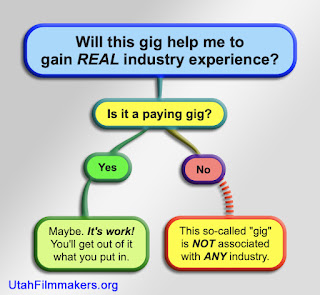
This flowchart can be applied
to almost any creative profession.

This does not mean that perpetual amateurs can’t make a living in the film industry—or at least within some corner of it—they just rarely get very far as “working amateurs.” They may refer to their income and the fact that they write “Filmmaker”—or a similar descriptor—in the “occupation” field of their 1040s as proof of their status in the industry. Still, they undermine it by engaging in amateur practices and behavior, like disparaging the local film communities they came from—and still rely upon for easily exploitable young talent. 

Amateurs who manage to find work in the industry despite their self-sabotaging habits offer cover for even more amateurs to disregard the tools of professionalism—making it appear obvious that one can “still get in” without them. The working amateurs count on this because only new amateurs are willing to work for predatory rates, to suspend their disbelief to accept that what’s happening to them is “normal” and it’s “how the ‘industry’ works!” Reinforced, whenever someone dares to complain, with “That’s how I started out.” Spoken with an odd mix of bitterness and pride, familiar to anyone who has confused exploitation for mentorship. Should anyone outside their sphere of understanding and influence point out unprofessional practices that working amateurs rely on to make their living, they may perceive it as a personal slight and waste little time attacking the messenger, usually by calling into question their professional bona fides.

Actual meme made by a working amateur
(Professionals don’t waste time
making petty insult memes)

Again, despite any personal prosperity they might enjoy in their particular corner of the industry, working amateurs are more than willing to maintain a narrative of a “struggling local market” to justify unfair wages and buyout terms that actual professionals—filmmakers and on-screen talent alike—would scoff at.

Some would insist that low rates are not necessarily an indicator of predatory behavior. Defensively claiming that they “can’t pay more,” referencing having to work within the constraints of a “micro-budget.”

This may or may not be in reference to SAG-AFTRA’s Micro-Budget Project Agreement. If it is, then the producers should be able to provide all of the necessary documentation to prove that theirs is, indeed, a signatory production. If it is NOT an actual signatory—the list of projects that do not qualify is clearly defined—then the producer may be misappropriating the term “micro-budget” as a catch-all excuse to pay their cast and crew as little as possible. Their motives may not necessarily be rooted in greed or shameless self-interest—amateurs will do whatever it takes to just get it done—a practice that always makes itself evident in the final product.

They tell themselves—and others—it’ll be better “on the next one.” Unfortunately, for every lesson that could inform their future efforts, they refuse to put in the work to learn how to get it right and settle for an amateur workaround to just get it done. They repeat their mistakes, confusing an expanding list of completed projects on their IMDb page for evidence of their creative growth. Some people are impressed with long lists of titles, especially if they don’t bother to watch anything on them. In reality, one needn’t commit to watching every title in the catalog of a faux-pro or working amateur to know why all of those “next” projects never pay off for their respective casts and crews. Just watch their first film, then watch their most recent film. Qualitatively, they’ll be almost indistinguishable.

Professionals understand that while getting paid is key to working consistently, how one gets paid for their work—i.e., embracing honest and ethical business practices—is also an important consideration.

Differences between amateurs and professionals

The reader is invited to consider the following juxtapositions of amateur and professional behaviors and honestly consider whether they reflect their own practices. New amateurs needn’t be embarrassed by what they read; they need only embrace some professional humility and apply what they learn.

Working amateurs are not likely to have read this far into the article—or even admit to identifying with that descriptor. On the off chance that this essay has come to their attention, one may hope that they can get something from it.

  • Amateurs typically undercut their competition to get the job now, but they devalue the work, making it harder for themselves—and established professionals—to make a living.

    • Professionals know the value of their time and talent and respect that of their colleagues.

  • Amateurs cut corners and take shortcuts to just get it done.

    • Professionals do what it takes to get it right.

  • Amateurs are impatient because they think they already know what they’re doing or they can figure it out.

    • Professionals know their own limitations and collaborate with others so all can benefit from each other’s unique skill sets.

  • Amateurs put a lot of time and effort into making the same mistakes repeatedly while never getting better at what they do.

    • When professionals make mistakes, they own them, learn from them, and grow from them.

  • Amateurs complain about rules getting in the way of work.

    • Professionals know that it’s the rules that make their work possible.

  • Amateurs are driven by their egos to reinvent the wheel.

    • Professionals will try and improve existing tools until something truly innovative and transformative replaces them.

  • Amateurs talk.

    • Professionals produce.

  • Amateurs get offended.

    • Professionals get to work.

Joe Puente

The opinions expressed in this blog are those of the author(s) and—especially where guest posts are concerned—do not necessarily reflect the official policies and/or practices of the Utah Filmmakers™ Association, its officers, and/or associates.