Showing posts with label networking. Show all posts

Monday, February 12, 2024

Joe Puente ponders “Film Day on the Hill”

Every year, during the bureaucratic lightning round that is Utah’s legislative session—from 2017–2020—there has been a designated “Film Day on Hill” held in the Capitol Rotunda in Salt Lake City.
Film Day 2018 image courtesy of
Utah Filmmakers Associate Marshall Moore

Coordinated by the Motion Picture Association of Utah (MPAU), it was always a fun time for friends and colleagues in the local film industry to gather to support Utah’s Motion Picture Incentive Program and the Utah Film Commission—the agency tasked with implementing it.

Film Day is often commemorated with a group photo!

Film Day 2020 image courtesy of the Utah Film Commission

The group photo from 2020 reminded me of a classic horror film, inspiring a short homage to the late director Stanley Kubrick.

Video by the author

Because of the pandemic, in 2021 and 2022, Film Day was an online event.

Coincidentally, February 17
is also the author's birthday.

Since 2023, Film Day has become part of “Cultural Industry Advocacy Day,” so the MPAU joins several other organizations and entities like Hogle Zoo, the Professional Outreach Programs In The Schools (POPS), the Utah Cultural Alliance, the Utah Museums Association, and Salt Lake County’s Zoo Arts & Parks (ZAP) Program, making for a more engaging public experience.

Film Day 2023 image courtesy of Utah Film Studios

I remember registering for Film Day last year and looking forward to it more than usual after two consecutive virtual gatherings—I even preordered a box lunch.

Alas, I was struggling with some intense anxiety and couldn’t make it—2023 had a rough start for me. Thankfully, UFA™ VP Mario DeAngelis could go, so the Utah Filmmakers Association was represented, and the lunch I had ordered didn’t go to waste.

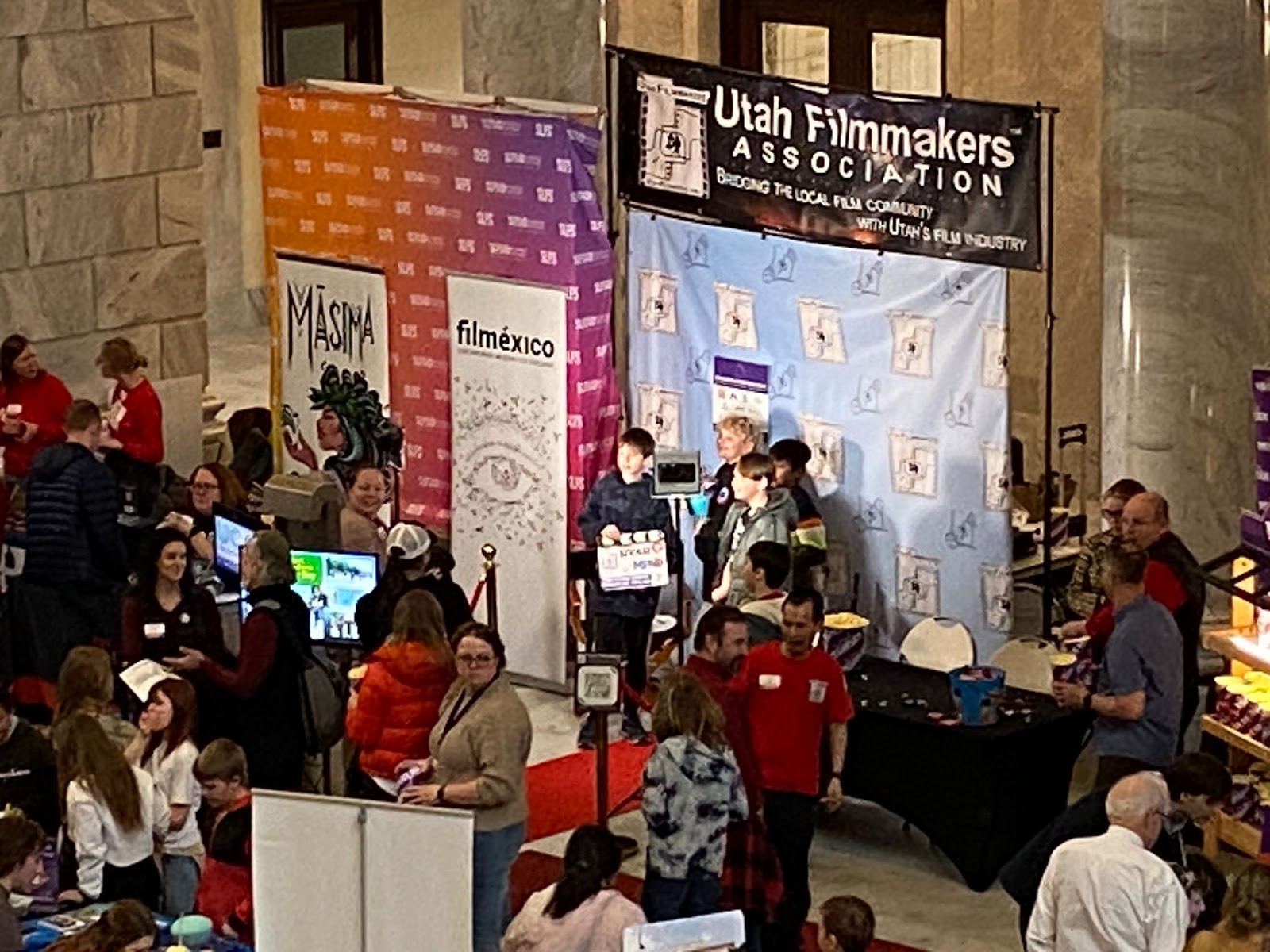
Cultural Industry Advocacy Day 2024 presented an opportunity for the UFA to connect with more of Utah’s film community, as well as other local nonprofits. We enlisted the services of Associate Member DB Productions Utah to answer a call from the event organizers at the Utah Museums Association to have an “interactive exhibit” in the Capital Rotunda. We were given a prime location between the Salt Lake Film Society and the Sundance Institute. Unfortunately, no one from Sundance was at their table. As we said in our Instagram post, “...we were happy to step up and make sure their allotted space still represented them. We happened to have a piece of Sundance Film Festival history... displayed on their table: An authentic Sundance Film Festival Rejection Letter. They don’t send those out anymore.

Dare I ask if the Utah Filmmakers Association stood out
among the other exhibitors? Images courtesy of the author

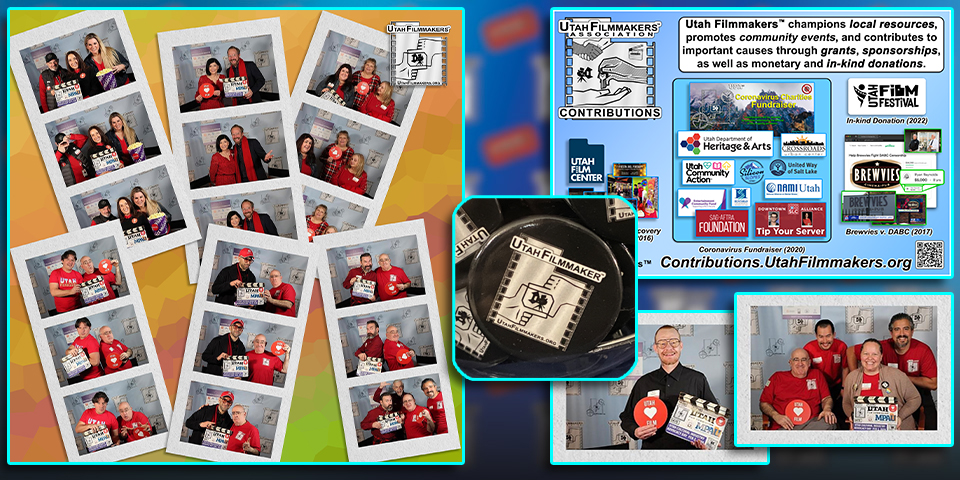
In addition to the novelty of DB Productions Utah’s signature photo kiosk—book them for your event today!—we gave out official Utah Filmmaker buttons.

Images courtesy of DB Productions Utah and Utah Filmmakers

We also presented two slide shows: One featuring our Associate Members and the other highlighting the organization’s engagement with the community, production support, and other contributions since its founding in 2002.

The slideshows were presented silently on the day, but the versions we’ve made available through YouTube—now featured on our website—have incorporated licensed soundtracks courtesy of Associate Organization Amphibious Zoo Music.

We also want to express our gratitude for the assistance of two of our Community Liaisons, Justin Kwan and Jared Palmer.

The opinions expressed in this blog are those of the authors and—especially where guest posts are concerned—do not necessarily reflect the official policies of the Utah Filmmakers™ Association, its Officers and/or Associates.


Tuesday, August 15, 2023

Integrity requires owning one’s mistakes

In the late summer of 2019, I contacted a member of our official forum via direct message to clarify some points of confusion in a recent comment thread. Our conversation was mostly productive, but I felt something was missing that couldn’t be effectively communicated online. So, I invited him to meet at a local coffee shop, which made all the difference. Travis Babcock is now one of our Official Forum Moderators and a Utah Filmmakers Associate.

One of the topics we discussed was the importance of mentorship for training new filmmakers. At the time, Facebook had implemented a mentorship feature that we enabled for the Utah Filmmakers group, and several members, including Travis, were able to get some productive use out of it.

While Facebook offered few tools for moderators to determine who was and was not qualified to effectively mentor novice filmmakers into the industry, Travis and I decided it could still serve as a pilot program for something more formal and organized. This included defining standards and a vetting process. One of the standards Travis recommended is part of our UFA™ Core Values:

Integrity

I asked Travis, “How does one assess a person’s integrity?”

His answer: “A willingness to own one’s mistakes.”

“I’ve made many mistakes,” Travis continued, “but I always owned them, learned from them, and rarely made the same mistake twice. This doesn’t mean that I don’t still make mistakes—because I do—but the ones I make now are much smaller than those I made when I was starting out.”

What I found especially appealing about this simple truth is that one can apply it anywhere: professionally and personally, in one’s work, art, and even in one’s relationships—be they social or in business.

As a filmmaker, every production presents new creative and technical challenges and opportunities to learn—opportunities that usually come in the form of mistakes made. Some mistakes just need a quick adjustment and a second take. Others can be “fixed in post.” Some can cost a shot, a scene, or even a production day. Sometimes, there is no fix, and what may have seemed like only a setback is the first sign of a complete failure.

As a member of the Utah Filmmakers™ group—especially in my role as an Administrator—I’ve made mistakes and tried my best to own them, rectify them, commit to learning from them, and—most importantly—be transparent about them.

The conversation between Travis and myself informed the creation of a mentorship program intended to go beyond what was offered in our Facebook group. Additional advice was sought, other tools researched, and a detailed proposal was written. The program was then presented to the Utah Film Commission, who agreed to help us with our vetting process—with a particular focus on the importance of integrity.

In 2021, the Utah Filmmakers Association received a modest grant to help promote this new program to attract mentors in the film industry and mentees committed to learning. We reached out to the local media and other nonprofit organizations. I made a couple of television appearances and radio interviews. Applications for potential mentors and mentees came in, many were selected, but a few were not. Mentors were assigned their mentees and provided with tools to help them facilitate their journeys.

I wish I could say that the program was a success and continues to meet its objectives, but being true to our organization’s core values of Professionalism, Integrity, and Respect, requires acknowledgment that it went nowhere. It was, for all practical purposes, a failed experiment. I wouldn’t call it a “spectacular” failure. It was pretty quiet and unremarkable—but no less of a disappointing experience, which reminds me of an important truth:

So, what did we learn from this failure?

That some things cannot be forced—no pun intended—into existence. We might be able to create and present opportunities, provide tools and make introductions, but we can’t predict what people will do or determine the final outcome. Some things lend themselves well to artificial facilitation, but only under specific circumstances. Others are just meant to happen organically, and that’s okay. It’s true of nonprofit programs, for-profit endeavors, and online communities. What’s important to remember is that one’s mistakes or failures are not an accurate gauge of one’s integrity, but how one responds to them can be very informative.

Joe Puente Founder/Administrator Utah Filmmakers™ Association


The opinions expressed in this blog are those of the authors and—especially where guest posts are concerned—do not necessarily reflect the official policies and/or practice of the Utah Filmmakers™ Association, its officers and/or associates.

Monday, August 17, 2020

A Message from Carolyn Leone and the MPAU

Hello Fellow Film Industry Professionals:

MPAU Board Members
Carolyn Leone, Michelle Moore,
and Ashley Cook.
My name is Carolyn Leone. I am the current President of the Motion Picture Association of Utah, (the MPAU). When not volunteering my time to the MPAU, I am a Costume Designer for Film and Television.

As you may or may not know, the main function of the MPAU is to provide a unified educating and lobbying force in the state of Utah, to support and grow our Motion Picture Incentive Program.


Due to a lack of adequate funding to this program, the state of Utah recently lost the television show YELLOWSTONE to our neighbor state Montana. The loss of jobs and tax revenue for Utah is indeed sad news.


The MPAU is currently working hard to build new and ongoing relationships with legislators as we head into a gubernatorial election year. Our top priority is to have our message heard by the new incoming administration. 


With the new school year starting, I am reminded of all the wonderful film programs we have in our state including those at the University of Utah, Brigham Young University, Utah Valley University, Salt Lake Community College, and SpyHop. Film and Digital Media programs turn out students who are eager to work in the film industry. The MPAU wants to make sure that these young bright minds are not forced to leave the state of Utah to start their careers. We want to keep our talent, money, and infrastructure in Utah.  I commend these institutions not only for the high-quality education they bring but also for their forbearance in keeping the wheels of education turning during this challenging time.


I could not be more proud of our film community in Utah. The willingness to pull together, and do what is necessary to make Utah a destination of choice for local filmmakers and filmmakers from around the country, and around the world, is nothing short of incredible. 


If you are not already a member of the MPAU, please do consider joining us. Not only do your membership dollars help with our educating and lobbying efforts, but you also help build our membership numbers, which builds our power and influence in growing our Motion Picture Incentive Program. Ultimately bringing more opportunities to everyone in our industry.


Join us today at mpau.org


The opinions expressed in this blog are those of the authors and—especially where guest posts are concerned—do not necessarily reflect the opinions or views of the Utah Filmmakers™ Association, its officers and/or associates.

Utah Filmmaker(s)™ and UFA™ are trademarks registered with the Utah Department of Commerce Division of Corporations and Commercial Code, Registration Numbers 10706542-0190 , 11025542-0190 and 10502093-0190 respectively.

Monday, July 13, 2020

Justus Page on the Director/DP relationship

Justus Page
My DP career began 6 years ago. What was my understanding of the Director/DP relationship back then? I was there to do what I was told. And yet inside I was angry because a part of me felt like that wasn’t right. I should have a say. But I felt too self-conscious in my abilities to be able to speak up. We existed with different expectations of each other.

This can be a very common experience for young DP’s and directors who are finding their footing. You might’ve been lucky to find someone you clicked with right at the beginning, but most are not so lucky. What is supposed to happen is an evolution of your working process. But let’s be honest; Is that what’s happening for YOU?

I think many people running in the independent/no budget circuit innocently never learned about this evolution. Nobody told them. Certainly, nobody told me. It was years of trial and error. But I found that in those roles, that evolution is a big part of your upward mobility in the industry.

Directors: Who is your cinematographer to you? Is it someone you hired to make your film look pretty? Naively, but understandably, this is often where our headspace can be, right? What’s your expectation of them? Are they there to hear your ideas and nod? Are they there to do what you tell them to? Do you want them to just show up and take command of the visuals entirely?

Image courtesy of the author
DP’s: What are you looking for in a director? Are you looking for someone to hand-hold you? Or someone completely hands-off who leaves you alone to do what you know best? You are the professional after all. A director who vomits meaning into every angle? Or a director who couldn’t care less, as long as it looks fine.

Let’s diverge from all of these entirely, and consider another possibility. Your DP/Director is your co-collaborator​. Some seasoned DP’s and Directors might scoff when they read this part because many of them understand this is how it’s supposed to be, ​duh​. But it’s not a given.

The first time I mustered up the courage and gave honest feedback on a script I was offered and the Director went “Oh, that’s a great insight! Let’s make that change,” my whole career evolved. I realized that I could insist on reading a script first, insist on giving feedback, and have an open dialogue with my prospective director. I realized I didn’t want to work with Directors who wouldn’t give me that consideration. But also, those that did showed me their ego was left at the door. They cared most about telling the best story, whatever form that took. It no longer mattered to me whether my director wanted to plan all the shots themselves, or whether they left all of that to me; My expertise was respected, my opinion was welcomed, and that created the type of working environment most conducive to doing our best work.

Image courtesy of the author
Shooting a pivotal moment in the film, the director could say, “Let’s do the shot like this,” and I could feel comfortable saying, “Actually, based on the discussions we’ve had about what we’re trying to say about this character, I think we might be better served doing this.” And guess what? The director can say “I disagree. Let’s do it my way,” and I am absolutely fine with that. That given respect is mutual. Oftentimes, conversations like the one above are avoided on the day, because I do extensive prep and planning with my directors involving look books, breakdowns, discussing character motivations, doing boards, writing shot lists, and religiously reading the script. This gets us all on the same page long before we walk on set.

Who are we as DP’s? We are the guardians of our Director’s vision. We are meant to champion their creative integrity and protect them however we can. We do this by doing everything in our power to understand them, ask 8 million questions until we’re sure we know what the expectations are and what they’re trying to achieve. We stand up for them if someone calls into question that integrity. We go the extra mile to be involved wherever we can, just to gain even an extra ounce of understanding of the vision.

As a Director, doesn’t having someone who champions these things sound exciting? Does it not sound like a weight off your shoulders? Can you sleep better knowing your vision won’t be compromised? Doesn’t it ease your tensions to know you can confide in your DP and ask them for their help? This is the world we’re all trying to live in. And it’s possible. But it takes vulnerability to open yourself up to this dynamic. You as a Director have to be open to ideas and to accept that help. You have to be open to being wrong, but also be comfortable being right, and knowing that standing your ground won’t ruffle any feathers because you’ve fostered this relationship. As DP’s we have to be open to considering ourselves as storytellers in our own right and respect ourselves enough to accept that our jobs are so closely tied to telling a story. Even if, at the end of the day, the Director gets the final word, we can allow ourselves to express our ideas to them openly, and ego-free.

In this day and age, it isn’t too hard to find someone who will make your film look good. But what about someone who makes your story better? Someone who’s invested in its success? Someone who wants to throw the full weight of their craft behind enhancing what’s on the page, and finding ways to make it even better than it was?

The key to being better storytellers for us all is collaboration. Don’t take my word for it. Go discover it for yourself! You’ll never go back to the way things were. And that, I can promise.

Feel free to reach out and open a dialogue! I’m always happy to chat!


The opinions expressed in this blog are those of the authors and—especially where guest posts are concerned—do not necessarily reflect the opinions or views of the Utah Filmmakers™ Association, its officers and/or associates.

Utah Filmmaker(s)™ and UFA™ are trademarks registered with the Utah Department of Commerce Division of Corporations and Commercial Code, Registration Numbers 10706542-0190 , 11025542-0190 and 10502093-0190 respectively.

Monday, January 14, 2019

Tell your state reps how the film incentive benefits you

(This post has been updated with the inclusion of a letter† sent to Senator Luz Escamilla and Representative Angela Romero from the Utah Filmmakers™ Association)

This article in the Salt Lake Tribune has been making the rounds in the Utah film community. It does a terrific job of illustrating how much government incentives benefit local film industries and professionals but—regardless of the amount of money being discussed—one can only read so much about “tax credits,” “rebates” and “GDP” impact before one’s eyes start to glaze over.

As important and informative as this article is, there's one section that I think should resonate with filmmakers on a personal level. It starts with Virginia Pearce, Director of the Utah Film Commission, talking about “the crew member who gets paid, who takes his wife out to dinner, who buys a new car, who is able to live and work here instead of living and working in L.A….”

It quotes Taylor Sheridan, the filmmaker behind the Utah-based production “Wind River,” who said of his Paramount Network series “Yellowstone” that it “…employs hundreds of people, and the vast majority of them are local… And the ones who are coming in, they’re renting properties, they’re standing in line at the grocery store. They’re staying here. They’re moving in… We show up and spend an extreme amount of money, employ a workforce... And showcase the state.”

It’s one thing to read about the film incentive’s benefits to the local economy in abstract terms but I think what was missing from this article was a more personal perspective.

The Motion Picture Association of Utah exists to inform the Utah state legislature about how important the film industry is to Utah’s economy and how integral the Motion Picture Incentive Program is to bringing productions into the state and employing local filmmakers.

It’s imperative that state legislators also hear from the people who benefit directly from a thriving local film industry: their filmmaking constituents.

Utah Filmmakers* can support their industry and the efforts of the MPAU by contacting their legislative representatives by phone, fax, letter, and e-mail and letting them know how the film incentives directly impact their lives.

Don’t know who your legislative representatives are? That’s okay. I voted and I still had to double check—I guess state legislators are more camera shy than those in federal office. Just visit https://le.utah.gov/GIS/findDistrict.jsp, plug in your address/zip code to find out who your representatives are and tell them how important the film incentives are to you personally.

As individuals, Utah filmmakers do not need to talk about GDP growth or the return on the state’s investments. Talk about how much you love your job and being able to make a living doing it in Utah. Better yet, how a more active industry would enable you to work full time—if you don’t already.

Talk about how landing that gig on a film or series that made use of the incentive is what kept a roof over your head in Utah, enabled you to support your family, buy locally and to take a more active part in your community.

Who among us doesn’t have a story of how a job came through at just the right time to take care of the bills or an unforeseen expense. If that job wouldn’t have been possible without the incentive, you need to let your representatives know about it.

The Utah legislative session starts on January 28, 2019. Contact your representatives TODAY!

—Joe Puente
Founder/Administrator
Utah Filmmakers™ Association

*As loosely defined by the Utah Filmmakers™ Association, “A ‘Utah filmmaker’ can be anyone based in Utah who’s involved in filmmaking including—but not limited to—Producers, Writers, Directors, Cinematographers, Animators, Actors, Sound Engineers, SFX/VFX Artists, Composers and many other technical and creative people.”

_____________________________________________

Utah Filmmaker(s)™ and UFA™ are trademarks registered with the Utah Department of Commerce Division of Corporations and Commercial Code, Registration Numbers 10706542-019011025542-0190 and 10502093-0190 respectively.

Tuesday, May 8, 2018

Social media and the local film community

Poster for the Utah-produced
film "Friend Request" (2013)
(Sense a theme in this entry?)
Independent filmmaking and social media seem like a natural fit. From networking and organization to flooding the newsfeeds of friends and groups with pleas for support and links to crowdfunding campaigns.

There’s no magic formula for creating a successful and engaging online forum where individuals can interact, seek advice and hire talent for their projects. Though it’s usually a simple matter of who gets there first, that doesn’t mean a newer forum won’t gain momentum and surpass the original(s).

Take, for instance, a little Facebook group started by this writer back in 2010 called “Utah YouTubers.” At first, it had only a handful of members and very little activity. Largely dormant for a number of years, around 2016 there was a surge in membership and activity. More and more people started to join and share their Utah-based YouTube content. It was later discovered that subsequent to—and completely independent from—the creation of that first “Utah YouTubers” group, another group with basically the same name had really taken off. Rather than try and compete, the original group was content to be associated with the more successful group and is now known as “UTubers Forum”, a public group that hopes to serve as a stepping stone to the more professionally-minded space catering to more experienced content creators.

As far as Facebook groups dedicated to filmmaking in Utah are concerned, there are several (as shown in the graphic below) and it’s not uncommon for someone new to the filmmaking community to join every single one that they find. However—as this writer discovered a number of years ago—one quickly learns that the membership of these groups consists largely of the same people. With an eye toward cleaning up one’s newsfeed of identical film-related posts from the same people, the question needs to be asked, “Which group do I join?” Or, more often, “Which group—or groups—can I just leave?”

The groups that aren’t doing anything or only engage members sporadically—usually because of low membership to begin with—are the easiest ones to let go of. One should also note which groups are posting the same information—in other words, find out which groups are populated by mostly the same people—and just stay in the one that’s most useful. Participate in the group that has experienced members that are willing to answer questions, offer sound advice and honest critique. Commit to the group that takes filmmaking seriously as both an art form and an industry.

Of course, the UFA™ is going to recommend the de facto group for Utah Filmmakers started by Ben Hawker, Utah Filmmakers and Actors. With the largest membership of any group of its type—over 13,400 and thousands of active participants at the time of this post—one can’t go wrong by clicking on that join button and answering the two basic screener questions for admittance: “What is the nature of your involvement in filmmaking?” and “Where in Utah are you based?” Since the group welcomes both film industry professionals and beginning filmmakers, it would be difficult to figure out an exact ratio of professionals to novices in the group without doing some exhaustive research. However, one can make a conservative estimate. Assuming that only 1 in 50 members of the group works or has worked full-time in the film industry with a guestimated average of ten years of on-set/in-studio experience, that's over 2,600 combined years of industry experience in our one group. That is a pretty impressive source of information and know-how that one can turn to.

While Utah Filmmakers and Actors is a valuable group for local filmmakers to be part of, there are other groups that cater to more specific topics of discussion such as Utah Film Writers and groups set up for local college and university film students. Another group that this author participates in is the Utah Video and Film Production group which offers a low-key but valuable discussion environment consisting largely of local industry professionals.

There are many other groups that have been started with goals similar to that of Utah Filmmakers and Actors. This writer is also a member of a few of them but doesn’t actively follow many of their news feeds for the simple reason that much of the information that they offer is identical and their community access limited to a significantly smaller audience—an audience that’s most likely also part of the Utah Filmmakers and Actors group, especially when it comes to novice filmmakers and those just starting to make inroads into the industry.

Redundancy can be a good thing when it comes to filmmaking—having a backup shooting location, extra lenses, mics and lighting options on hand in case of unexpected complications, for example—but when it comes to resources for hiring, networking and collaboration, it can be confusing. The fact that a few of these other groups have actually been started by existing and former members of Utah Filmmakers and Actors—for reasons that include disagreements with group policies and/or admins acting in accordance with said policies—doesn’t help either.

Graphic created by the author,
derived from publicly sourced data.
Higher Resolution Version
_________________________________________

Utah Filmmakers™ and UFA™ are trademarks registered with the Utah Department of Commerce Division of Corporations and Commercial Code, Registration Numbers 10706542-0190 and 10502093-0190 respectively.