Showing posts with label MPAU. Show all posts

Monday, February 12, 2024

Joe Puente ponders “Film Day on the Hill”

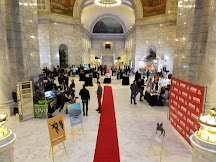
Every year, during the bureaucratic lightning round that is Utah’s legislative session—from 2017–2020—there has been a designated “Film Day on Hill” held in the Capitol Rotunda in Salt Lake City.

Film Day 2018 image courtesy of
Utah Filmmakers Associate Marshall Moore

Coordinated by the Motion Picture Association of Utah (MPAU), it was always a fun time for friends and colleagues in the local film industry to gather to support Utah’s Motion Picture Incentive Program and the Utah Film Commission—the agency tasked with implementing it.

Film Day is often commemorated with a group photo!

Film Day 2020 image courtesy of the Utah Film Commission

The group photo from 2020 reminded me of a classic horror film, inspiring a short homage to the late director Stanley Kubrick.

Video by the author

Because of the pandemic, in 2021 and 2022, Film Day was an online event.

Coincidentally, February 17
is also the author's birthday.

Since 2023, Film Day has become part of “Cultural Industry Advocacy Day,” so the MPAU joins several other organizations and entities like Hogle Zoo, the Professional Outreach Programs In The Schools (POPS), the Utah Cultural Alliance, the Utah Museums Association, and Salt Lake County’s Zoo Arts & Parks (ZAP) Program, making for a more engaging public experience.

Film Day 2023 image courtesy of Utah Film Studios

I remember registering for Film Day last year and looking forward to it more than usual after two consecutive virtual gatherings—I even preordered a box lunch.

Alas, I was struggling with some intense anxiety and couldn’t make it—2023 had a rough start for me. Thankfully, UFA™ VP Mario DeAngelis could go, so the Utah Filmmakers Association was represented, and the lunch I had ordered didn’t go to waste.

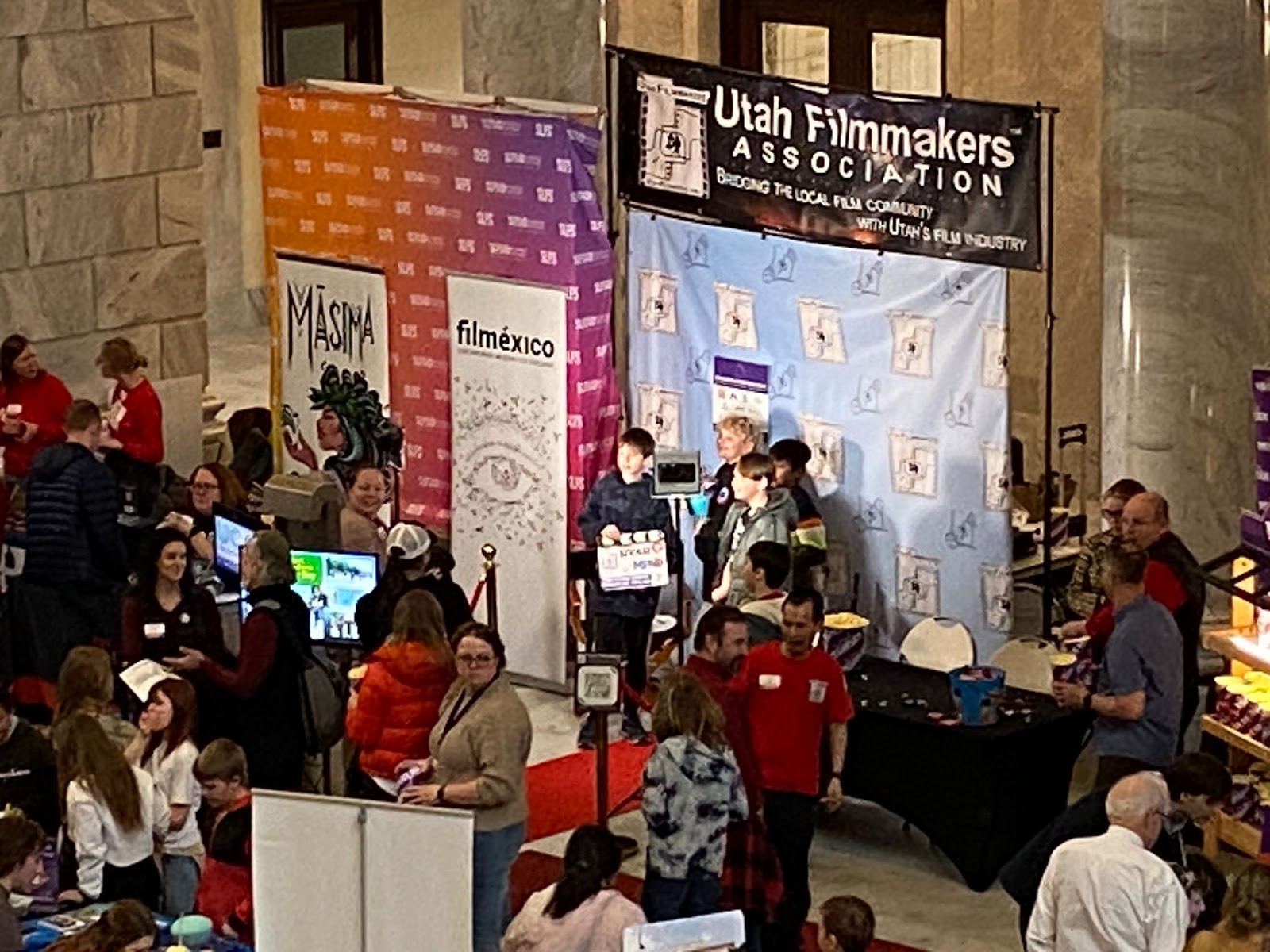
Cultural Industry Advocacy Day 2024 presented an opportunity for the UFA to connect with more of Utah’s film community, as well as other local nonprofits. We enlisted the services of Associate Member DB Productions Utah to answer a call from the event organizers at the Utah Museums Association to have an “interactive exhibit” in the Capital Rotunda. We were given a prime location between the Salt Lake Film Society and the Sundance Institute. Unfortunately, no one from Sundance was at their table. As we said in our Instagram post, “...we were happy to step up and make sure their allotted space still represented them. We happened to have a piece of Sundance Film Festival history... displayed on their table: An authentic Sundance Film Festival Rejection Letter. They don’t send those out anymore.

Dare I ask if the Utah Filmmakers Association stood out
among the other exhibitors? Images courtesy of the author

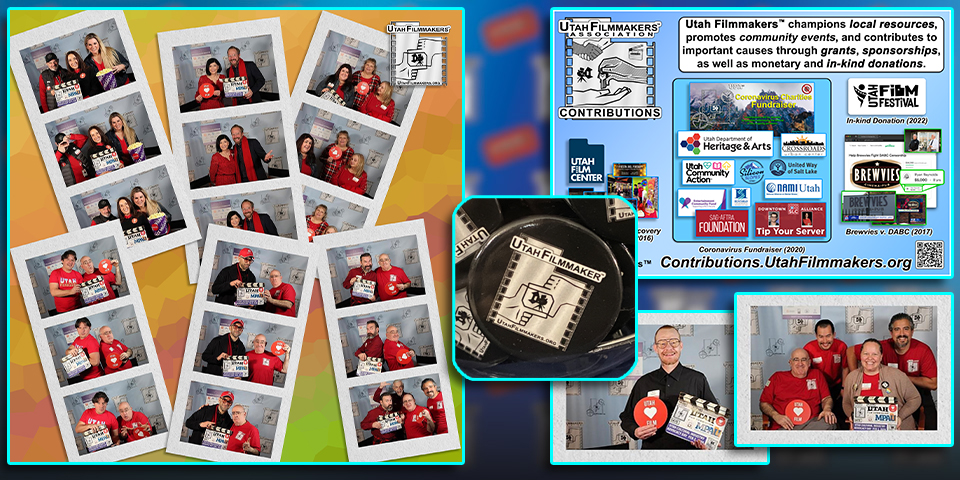
In addition to the novelty of DB Productions Utah’s signature photo kiosk—book them for your event today!—we gave out official Utah Filmmaker buttons.

Images courtesy of DB Productions Utah and Utah Filmmakers

We also presented two slide shows: One featuring our Associate Members and the other highlighting the organization’s engagement with the community, production support, and other contributions since its founding in 2002.

The slideshows were presented silently on the day, but the versions we’ve made available through YouTube—now featured on our website—have incorporated licensed soundtracks courtesy of Associate Organization Amphibious Zoo Music.

We also want to express our gratitude for the assistance of two of our Community Liaisons, Justin Kwan and Jared Palmer.

The opinions expressed in this blog are those of the authors and—especially where guest posts are concerned—do not necessarily reflect the official policies of the Utah Filmmakers™ Association, its Officers and/or Associates.


Monday, November 6, 2023

Economic impact of local productions - Symposium Reflections - Part III

How much of an impact can a film project have on the local economy?

The Motion Picture Association of Utah (MPAU) commissioned an Economic Impact Study of Utah’s film industry, emphasizing the benefits of the state’s Motion Picture Incentive Program (MPIP)—colloquially referred to as the “film incentive.” The MPAU summarized the study in an explainer video.


In short, the state—through the Utah Film Commission—invites filmmakers worldwide to produce their movies and series in Utah by highlighting local resources such as unique filming locations, support services, experienced crew members and actors, etc. The film incentive—a 25% rebate—is available to qualifying productions that spend a defined amount of their production budget within the state. For example, if a film production spends $1,000,000 in Utah—a claim that has to be verified by a third-party audit—they may receive a rebate of up to $250,000.

The impact of money spent on film and television production in Utah is not limited to the local film industry; it’s also advantageous for ancillary industries and sectors as well. Fees for location permits benefit municipal, county, and state governments. Hiring local crew members and actors, catering and vehicle rental, hotel accommodations, renting equipment, and studio space benefit local businesses, enabling them to pay their employees. Employees pay local taxes; they buy groceries and pay for their housing and transportation, and myriad goods and services for their personal needs, benefiting even more local businesses, who have their own payrolls to meet. They may not even realize that the film industry’s economic impact also works to their advantage.

This begs a more specific question: How much do film projects by local filmmakers affect the local economy?

The answer depends on whether or not—and to what degree—those local filmmakers understand and accept that the business of filmmaking cannot be separated from the art form.

As I’ve previously discussed, in the Venn diagram showing how creative industries and their adjacent communities overlap, local filmmakers may find themselves in one of three archetypical roles: Industry professionals, working-amateurs, and faux-professionals.

There are indeed a number of Utah-based film industry professionals. They understand and respect that filmmaking is as much a business venture as it is one of artistic expression. They have established effective and sustainable business models. They understand that prioritizing people with fair compensation is essential to creating a quality film that can see a return on investment. One important characteristic they all share is knowing that no one person can do it all. They know their professional strengths, have the integrity to acknowledge their limitations and respect the varied, complementary talents of those they work with, trusting them to do the same. They embrace the standards and best practices of the industry, maintaining due diligence through all stages of production and effectively managing assets and required deliverables from concept to distribution. This is what professional industry filmmakers do: employing themselves and others, doing their part to sustain the industry, and making a quantifiable difference in the economic landscape.

The working amateurs are those filmmakers who have managed to corner a niche within the local market that’s technically part of the larger industry, embracing business models with a modicum of sustainability—at least for those above the line. Their priorities are in the saleability of the finished product with a maximum return on a miserly investment. They don’t embrace industry standards so much as meet minimal requirements. Best practices will almost always be substituted with whatever they can get away with legally, if not ethically. If a loophole will save them money on production, they’ll find it and exploit it. They understand the business well enough to know that a mediocre film—with a built-in, albeit less discerning, audience—that’s done its due diligence has a better chance at distribution and profitability than an otherwise flawless work of art that can’t produce a chain of title, signed contracts, and/or other deliverables that reputable distributors will ask for.

Faux-professionals are well-versed in the jargon associated with their craft. They take themselves—if not the art form—very seriously, an unfortunate and potentially volatile combination of the Dunning-Kruger effect and unchecked narcissism run amok. More often than not, the responsibility for the unsaleable nature of many local productions—I’ll refer to them hereinafter as “community films”—rests squarely with faux-professional community filmmakers. Having never let go of amateur thinking, they prioritize the completion of a film over its distribution, assuming that the completed project will be so good that it will sell itself—grossly underestimating the importance of basic business planning and the necessity of due diligence. They are so focused on getting to say “That’s a wrap” to the applause of an exhausted and under-compensated crew that every decision they make leading up to that point is rooted in a scarcity mentality. Problems that can easily be avoided by not starting preproduction until proper funding is in place are simply dealt with along the way. Lacking any practical means to hire the professionals needed to do the job right, they cut corners just to get the job done, starting—most often—by requiring most of their cast and crew to waive or defer payment and convincing those above-the-line to accept rates that aren’t just below industry standards but even fail to meet the federal minimum wage.

Faux-professionals like to refer to themselves as “in the industry” because they sincerely believe that they are. Actual film industry professionals may beg to differ. Finished “community films” exist only on the outer-most fringes of the film industry—assuming someone remembered to create IMDb entries for them, as promised to many a cast and crew, in lieu of a paycheck. This speaks to the economic impact of such projects; there is none—people can’t pay rent or buy groceries with deferred salaries.

Despite the excitement they tend to engender in the local film community—I don’t think community films actually benefit anyone. To be frank, I think that they do more harm than good. Exploited actors and crew are prevented from learning the actual value of their time and talent. They become so accustomed to “donating” or underbidding their services and paying the “passion tax” that when they’re presented with an offer that industry veterans would scoff at, they accept it without question or even any negotiating on their behalf by their so-called “agents”—because 15% of a lousy offer is still better than 15% of a client’s “experience” and IMDb credit. This undermines the income potential for other local actors and crew. A desperate labor market attracts predatory employers. While some may be quick to point fingers at incentivized productions hiring local background talent for less than half of what SAG-AFTRA deems as an acceptable minimum day rate, some Utah-based producers, including the working amateurs described above, also exploit that desperation. While it might be good for their bottom line in the short term, the practice is simply not sustainable.

The opinions expressed in this blog are those of the authors and—especially where guest posts are concerned—do not necessarily reflect the official policies and/or practice of the Utah Filmmakers™ Association, its officers and/or associates.

Monday, August 17, 2020

A Message from Carolyn Leone and the MPAU

Hello Fellow Film Industry Professionals:

MPAU Board Members
Carolyn Leone, Michelle Moore,
and Ashley Cook.
My name is Carolyn Leone. I am the current President of the Motion Picture Association of Utah, (the MPAU). When not volunteering my time to the MPAU, I am a Costume Designer for Film and Television.

As you may or may not know, the main function of the MPAU is to provide a unified educating and lobbying force in the state of Utah, to support and grow our Motion Picture Incentive Program.


Due to a lack of adequate funding to this program, the state of Utah recently lost the television show YELLOWSTONE to our neighbor state Montana. The loss of jobs and tax revenue for Utah is indeed sad news.


The MPAU is currently working hard to build new and ongoing relationships with legislators as we head into a gubernatorial election year. Our top priority is to have our message heard by the new incoming administration. 


With the new school year starting, I am reminded of all the wonderful film programs we have in our state including those at the University of Utah, Brigham Young University, Utah Valley University, Salt Lake Community College, and SpyHop. Film and Digital Media programs turn out students who are eager to work in the film industry. The MPAU wants to make sure that these young bright minds are not forced to leave the state of Utah to start their careers. We want to keep our talent, money, and infrastructure in Utah.  I commend these institutions not only for the high-quality education they bring but also for their forbearance in keeping the wheels of education turning during this challenging time.


I could not be more proud of our film community in Utah. The willingness to pull together, and do what is necessary to make Utah a destination of choice for local filmmakers and filmmakers from around the country, and around the world, is nothing short of incredible. 


If you are not already a member of the MPAU, please do consider joining us. Not only do your membership dollars help with our educating and lobbying efforts, but you also help build our membership numbers, which builds our power and influence in growing our Motion Picture Incentive Program. Ultimately bringing more opportunities to everyone in our industry.


Join us today at mpau.org


The opinions expressed in this blog are those of the authors and—especially where guest posts are concerned—do not necessarily reflect the opinions or views of the Utah Filmmakers™ Association, its officers and/or associates.

Utah Filmmaker(s)™ and UFA™ are trademarks registered with the Utah Department of Commerce Division of Corporations and Commercial Code, Registration Numbers 10706542-0190 , 11025542-0190 and 10502093-0190 respectively.

Thursday, October 10, 2019

Thoughts on film budgets

Budget breakdown for "Excursus"
A short film by the author—
with which he proposed to
his wife (who said yes).
One day, I was on the set of a corporate production and around lunchtime I was sitting with some of the crew members, talking shop. A newer member of the crew was asking one of the veterans about budgeting for a production. With appetites growing, catering and craft service was used as an example. Crafty can be budgeted by setting a dollar amount per day per person on the cast and crew. Allot $10 per person on a small 10-person production and your craft service budget will be $100/day. You’ll certainly want to be more generous and flexible when it comes to catering meals, especially if you opt to hire different caterers throughout the course of the shoot to add some variety to the menu. Productions—regardless of what they’re shooting—are often judged by the quality of their craft service and catering. In my budget template, “Comestibles” (Food) is the first item “Below-the-line” for that very reason.

Another question that was asked was, “Where in the budget can you most easily save money?”

Frugality, when budgeting for any film is always wise but I’m of the opinion that before one asks, “where can I save money?” One simply needs to become informed as to what the standard rates and fees are in order to properly estimate the required budget for a production. This is especially true if one is producing a project for a client. The client could be a business investing in a television commercial, or it can be an investor backing a feature film.

Knowing how much production services cost—and not forgetting that one needs to include their own fair wages—is essential to making a realistic budget estimate. When the client inevitably asks, “Can you do it for less?” the answer should never be “Yes.” It should be, “Only if you want to change the scope of the production and lower your expectations.”

Once production is rolling, and one has a defined budget for what they have been contracted to do, opportunities to save money may certainly present themselves. However, the way one saves money on a production and how one uses that savings should be informed by ethical business practices and the law.

Unfortunately, it is not uncommon for budgeted productions to request “volunteers” in front of and behind the camera, regardless of the fact that the practice is illegal. A producer may justify this practice—called “wage theft”—for any number of reasons, from saying that they’re “saving the client money” to trite appeals to artistic egos but it doesn’t change the fact that the practice opens up the production (and the client) to some severe legal ramifications that could cost much more than the savings envisioned by using unpaid labor.

In the case of productions that expect to take advantage of government-funded film incentives, the motivation to "save money" in the short-term negatively affects not only the people convinced to work for free but the bottom-line of the production itself.

If a project is approved for a film incentive rebate of 25% based on their commitment to spend at least $1 million dollars in the state, cutting corners through wage theft will directly impact the amount of money they would receive for their rebate.

For example: getting 100 people to be free extras for a simple crowd scene might save the production $10,000 for one day but NOT spending that money can, at best, shrink the production's rebate check by $2,500. Or worse. When all the receipts are counted, the budget has been properly audited and it turns out that not paying extras that one time was all it took to cut their in-state expenditures to less than $1 million dollars thus disqualifying them for the 25% rebate.

That $10,000 saved on one day of production would wind up costing $250,000. It's not uncommon for producers to count on incentive rebates to fund or at least supplement their post-production budget. And all it takes to screw it up is a short-sighted UPM or Line Producer to make an unethical and illegal decision because they think they're doing their employers a favor by "saving" them some money on a single day of production.

Bottom line, one should never try to save money at the expense of the people that are working for them. If one has given an accurate and fair budget estimate to a client and the client has agreed to it, there should be no excuse for asking—or requiring—anyone to work for less than a fair rate, especially if it means that a budget surplus is only going to be used to inflate one’s own reimbursement for their services as a producer. I can’t think of any producer that has used a budget surplus to refund their client/investor because they overestimated the cost of the production. Being able to make a reasonable profit for the work one does is an essential factor in making fair and accurate budget estimates.

When budget-saving opportunities present themselves, one needs to ask,
“Will any one person be negatively affected by this decision?”
For example: If one has allotted $2000 in their budget to secure the use of a location—based on typical rates for similar locations—and then learns that the owner/manager of said location only charges $1000 or its use. Before popping open the wrap party champaign, the question must be asked
“Will any one person be negatively affected by this decision?”
If $1000 is the standard fee, determined to be fair and worthwhile by the owner/manager, then the answer to the above question is, “No.”

Congratulations! That’s a $1000 budget surplus—assuming, of course, that the rest of the budget balances out at the end of the shoot.

So, what do you do with that savings?

One option of what to do with any budget surplus during production is to simply allot it to the contingency fund. Every production should include a “Contingency” line-item equal to at least 10% of the entire production budget. These funds are set aside from the beginning in order to cover unexpected expenses, and any minor differences between estimates and actual rates and fees for the production.

If a piece of equipment is damaged and needs to be repaired or replaced immediately, so the pace of production isn’t hindered, contingency funds can be used to cover those costs and those receipts provided to the production’s insurance company for reimbursement.

If one has fairly estimated the cost of a crew member’s rate and kit fee and the actual cost is slightly more than the estimate, don’t ask the crew member to give you a discount or to waive their kit fee just to match the estimate. Pay them what their knowledge and experience have determined is fair. Contingency funds exist to make up that difference.

If a new contractor has offered the production a valuable service for considerably less than what has been budgeted only because they’re new to the industry and have not yet grasped the value of their work, before just agreeing to their lower fee, ask the question:
“Will any one person be negatively affected by this decision?”
The new contractor would certainly be affected, even if they don’t realize it. One must also consider that agreeing to that lower fee may result in a budget surplus but it would be unethical and potentially detrimental to the segment of the industry that the contractor represents. Undervalued services often result in more knowledgable and experienced contractors having to lower their rates in order to be competitive while hurting their ability to make a living at what they do. So, it isn’t just one person being negatively affected, it has the potential to affect an entire segment of the industry. So, the answer to the above question is “Yes!”

It’s also important to remember that, in this scenario, we’re working within an approved budget. The funds are there to compensate cast and crew fairly so there is no excuse to exploit someone’s naïveté in the interest of “saving money” that's already been earmarked for necessary expenditures. The client has already agreed to the amount, fully understanding the inherent risks involved in such an investment. Worrying about the risk that a client is taking is not part of the producer's job description.

There are already too many established filmmakers that approach budgets with a “scarcity” mentality. Being knowledgable about the value of the work that goes into a production and standing firm with clients/investors about having realistic expectations when it comes to appropriate budget estimates will help ensure that the work is valued and respected.

The contract may still go to the lowest bidder, but at least the difference in cost will be based on reasonable variables in an estimate and not a deliberate effort to undercut the competition and devaluing the work.

Joe Puente
Founder/Administrator
Utah Filmmakers
_____________________________________________

Utah Filmmaker(s)™ and UFA™ are trademarks registered with the Utah Department of Commerce Division of Corporations and Commercial Code, Registration Numbers 10706542-0190 , 11025542-0190 and 10502093-0190 respectively.

Monday, March 11, 2019

Owning a “label” as a filmmaker


This image is NOT of Brian Higgins
but most Utah Filmmakers who see it
may say, “Oh, yeah, I know Brian.”
When I think of Utah’s film community, there are only a handful of people that might be worthy of a label like “Icon.” One of these local film icons is Brian Higgins. Probably best known for producing Salt Lake City’s annual 48 Hour Film Project, Brian is also the mind behind the Filmulate Genre Festivals that take place throughout the year.

CreateReelChange.org
Another endeavor that Brian is committed to is his non profit organization, Create Reel Change, founded to educate and promote understanding and acceptance of mental health issues through creativity, so it came as no surprise when Brian decided to lend his support to the Labeled Festival for Mental Health and the efforts of its parent organization, Alliance House in Salt Lake City.

LabeledFest.org
“Labeled Fest” starts at noon on May 11, 2019, at Library Square. Film submissions will continue to be accepted until March 20, 2019.

The “label” that this festival refers to is that which tends to be assigned to those who are proactive about seeking treatment for mental illness—and don’t hide it. While “labels” associated with various mental health diagnoses are often used pejoratively, the aim of the Labeled Festival is to help “take it back” with an eye toward removing any perceived stigma.

While my own efforts to maintain my mental health have never been a secret, I do try to be mindful when it comes to recognizing when it is or isn’t appropriate for discussion—especially within a professional setting. Considering the attention that Labeled Fest and Create Reel Change bring to the issue within the context of filmmaking, I feel encouraged to share some of my personal experiences and how they’ve affected me as a filmmaker.

I know and have worked with a number of people in the local film industry who function with various mental health diagnoses from clinical depression to bipolar disorder, general anxiety and other mental illnesses. They all do their best to manage their mental health while being productive, contributing their time and talent to the local industry, and growing as artists.

I’ll spare you a comprehensive mental health self-evaluation and limit my sharing to what can be an ancillary symptom to many mental illnesses as well as a singular diagnosis. It’s also something the most people have experienced at one time or another, especially those of us in creative fields.

Anxiety!

To give you an idea of how debilitating anxiety can be, when I first started writing this essay—just three paragraphs in—I started feeling really anxious and had to step away from it. What I thought would just be a short break to administer some self-care turned into a day of worry that not only affected my ability to write but also impeded progress on a film project with a looming deadline.

It was about 24 hours before I was able to compose myself enough to finish writing it and I’ve been pretty much white-knuckling it ever since.

These are feelings that I know just about every actor experiences, regardless of whether they’re auditioning for a community theater production just for the love of it or if they’re an award-winning industry veteran preparing for a role written specifically for them in a big-budget feature film or series.

Anxiety is also experienced by creatives behind the camera, especially in high pressure positions like writers, producers and directors but, guess what, it doesn’t matter what job you might have on a project, you could be a cinematographer or a production assistant and still become virtually paralyzed by an unexpected panic attack.

Utah Film Commission
In my work as the Administrator for the Utah Filmmakers™ Association, I find myself enduring some intense anxiety even when I’m just working at home behind my computer (I’ll refer you to my experience writing this essay as described above). The nature of an “association” strongly suggests that I need to associate myself with others in the industry which means making an effort to go to local film-related events—and occasionally organizing them. This triggers my anxiety to an intense degree, so much so that I’ve had to cancel plans to participate in events at the last minute; most recently, Film Day on the Hill, which took place not long after I had been in contact with the Utah Film Commission and the Motion Picture Association of Utah. I certainly had a professional imperative to be there as a filmmaker and I wanted very much to show my support—and by extension that of the UFA™—by connecting with other industry professionals in person but my Generalized anxiety disorder had other plans for my physical person.

One thing that I’ve learned though is that my colleagues in the film industry are much more understanding of these challenges when I’m honest about them. To share with you another example, in December of 2018, I had a meeting with the leadership of another film-related non profit organization. When I was asked to briefly describe the mission of Utah Filmmakers™, I started to speak and then began to stutter—quite a bit. I paused for a moment, remembering that sometimes an anxiety attack can present itself as stuttering and stumbling over one’s words. I smiled, looked to my colleagues and said, “I apologize. I’m feeling a bit of anxiety.”

They all smiled back at me, expressed their understanding and patiently allowed me a moment to collect myself and continue. I can’t help but wonder how that would have gone over in a different industry where creativity isn’t as integral to the work that’s done. Speaking with one of these colleagues again on the phone, they mentioned to me experiencing “nervous energy” in anticipation of an upcoming event and I was glad to be able to express my empathy. I wondered if we were both reminded of my anxiety-induced stammering.

Utah Filmmakers Meet & Greet
When I am able to make it to film industry and community networking events, it takes a great deal of effort on my part not to isolate myself with familiar faces and I’m not always successful. Many people who are not accustomed to speaking or performing in front of an audience will find what I'm about to say incredibly ironic but I find it much easier to address a large group of people than to make small talk and meet them one-on-one. I enthusiastically jump at the chance to do so at events like Sue Rowe’s Utah Filmmakers Meet & Greets. Before I thank the host for the opportunity to speak and ask everyone to join the Facebook group if they haven’t already done so, I start off by saying something to the effect of, “I’ve got to run soon but before I do…”

I imagine that this little caveat might make it appear to others that I must be a very busy man with a number of projects on my plate, places to go and important people to see. If I haven’t been given the chance to speak to the room, I try to seek out the organizer and say, “I’ve got to run but before I do, I want to thank you…” and they may very well infer the same thing.

While I usually do have a number of projects on my plate, occasionally go places and get to meet important people once in a while, I have a confession to make:

“I’ve got to run,” more often than not, is just my way of saying that my anxiety is really elevated and I need to go home to deal with the panic attack that I knew all along would be coming.

In the end, I would rather pay that price to attend an event for the sake of the art that I love and the community that I adore than regret not having gone at all. It’s also one of the reasons that I started the Utah Filmmakers™ Community Liaison Program. It is a genuine effort to raise awareness of the organization but it’s also to make up for those times when I can’t be somewhere even when I want to be, more than anything.

Joe Puente
Founder/Trustee
Utah Filmmakers™ Association

Addendum (16 March 2019):

I went to a short film screening last night… There were a lot of people there. It was pretty awesome. I said hi to one of the proprietors of the venue, took some photos and shared them online, dropped off some business cards and went home before the screenings actually started simply because I was feeling anxious.

I’m still glad that I made it out there though. It looked like everyone was having a great time and the night was definitely a success for those who planned it—and my ducking out early probably didn’t even register with anyone and that’s okay.

As I’ve said before, everyone experiences anxiety from time to time—some of us are affected by it more than others—and it’s important to remember that it’s not anyone’s fault. Panic attacks—mild, moderate and severe—just happen, affecting different people for different reasons. Sometimes, there are circumstances that can predictably elevate someone’s anxiety. Sometimes anxiety shows up when you least expect it. No matter when or where it happens, no one can take responsibility for someone else’s anxiety any more than they can for the fact that someone’s pupils will dilate when it gets dark.

This experience also reminded me of times that I’ve experienced anxiety on set and have witnessed others experiencing it. One of the ways that anxiety manifests itself is through irritability. Something to consider the next time a person might appear to be acting “difficult” in a high pressure situation. That’s not to say that those of us who struggle with anxiety should just get a pass for anything they might say or do when our anxiety is elevated. Those of us who have come to be aware of these challenges, are able to recognize their feelings of anxiety, and identify what may be causing them, have a responsibility to learn how to manage those feelings—principally for their own benefit but also when they are working, especially in a collaborative environment such as a film set.

I have been in situations where I needed to bring what I was experiencing to the attention of a crew member—usually a 1st or 2nd AD. By being honest about it, the production had the information that it needed to maintain its momentum. It’s better to be aware and prepared to be flexible with the order of scheduled events than for something to unexpectedly halt production—all due to a lack of communication rooted in fear of embarrassment. More often than not, just knowing that my crew was aware and understanding of what I was dealing with was enough to help me focus on the task at hand.

I’m sure that most people with on-set experience can remember a time when off-camera drama affected the crew’s ability to capture the drama that was scripted. If we’re being completely honest, it was usually an actor. When something like that is witnessed on a film set, it’s considered unprofessional behavior regardless of any underlying cause. Film and television production is an intense, high-pressure work environment and one of the responsibilities that everyone has on set is to manage their stress in a professional manner. Acknowledging a potential problem is professional, allowing a potential problem to turn into an actual problem is not.

I try my best to maintain my professionalism on set and—just like everyone else on the planet—I’m not always successful. But when I see someone just abandon all responsibility in service to their own ego, potentially sending the whole production off the rails, there’s part of me that wants to say, “Pull yourself together! You think the rest of us aren’t feeling the same pressure you are? Get back to work! You don’t see me losing it! I power through and save the panic attack, tears and IBS symptoms for when I get home!…That’s because I’m a professional.”
_____________________________________________

Utah Filmmaker(s)™ and UFA™ are trademarks registered with the Utah Department of Commerce Division of Corporations and Commercial Code, Registration Numbers 10706542-0190 , 11025542-0190 and 10502093-0190 respectively.